
A mesial impaction wisdom tooth occurs when your third molar angles forward toward your second molar. This common dental issue affects millions of people and often requires professional intervention. Understanding your options helps you make informed decisions about treatment.
Key Takeaways
✓ Mesial impaction represents the most common type of wisdom tooth impaction, affecting approximately 40% of cases
✓ Early detection through dental X-rays can prevent damage to adjacent teeth and reduce complications
✓ Extraction costs in 2025 range from $225-$600 per tooth depending on complexity and location
✓ Recovery typically takes 7-14 days with proper post-operative care and pain management
✓ Leaving impacted wisdom teeth untreated can lead to cysts, infections, and damage to neighboring teeth
Understanding Mesial Impaction Wisdom Tooth
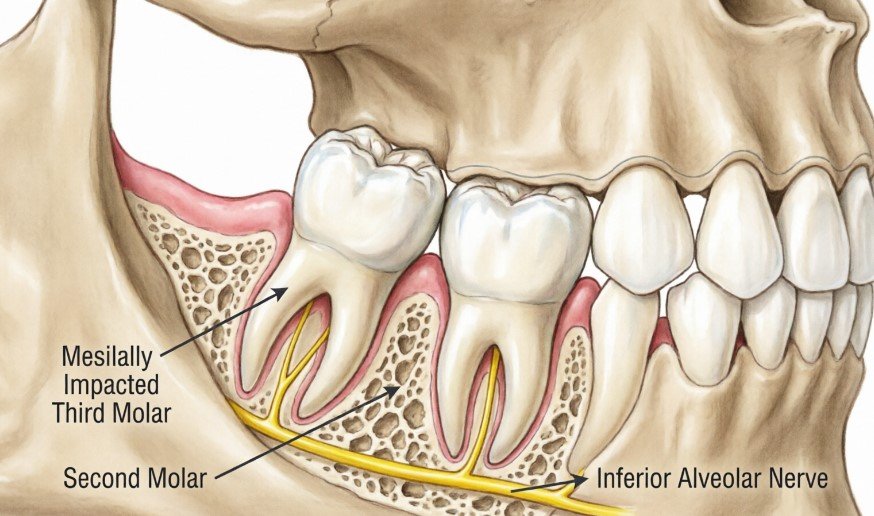
When a wisdom tooth grows at an angle pointing toward the front of your mouth, dentists call this mesial impaction. This positioning creates unique challenges because the tooth pushes against the molar in front of it. The pressure can cause pain, crowding, and potential damage to healthy teeth.
What Causes Mesial Angulation?
Several factors contribute to this dental condition. Your jaw simply may not have enough space to accommodate all 32 teeth. Modern humans have smaller jaws compared to our ancestors, yet we still develop the same number of teeth. This evolutionary mismatch creates problems.
Genetics play a significant role too. If your parents experienced impacted wisdom teeth, you likely will as well. The timing of eruption matters—wisdom teeth typically emerge between ages 17 and 25, though some people never develop them at all.
How Common Is This Condition?
Research from 2025 shows that mesial impaction accounts for roughly 40-45% of all wisdom tooth impactions. This makes it the most frequently diagnosed type. Approximately 85% of wisdom teeth eventually require removal, with mesially angled teeth ranking highest on the extraction list.
| Impaction Type | Prevalence Rate | Typical Treatment |
|---|---|---|
| Mesial | 40-45% | Extraction recommended |
| Vertical | 30-35% | Monitoring or extraction |
| Horizontal | 10-15% | Extraction required |
| Distal | 5-10% | Case-by-case basis |
Signs and Symptoms to Watch For
Recognizing the warning signs early can save you from serious complications. Not everyone experiences obvious symptoms, which makes regular dental checkups essential.
Pain and Discomfort Patterns
Most people feel pressure or dull aching in the back of their mouth. The pain might come and go initially, becoming more persistent over time. You could experience headaches, jaw stiffness, or difficulty opening your mouth fully.
Swelling around the gums near the affected area often accompanies the discomfort. Some patients report pain radiating to their ears or temples. Chewing becomes challenging, and you might notice yourself favoring one side when eating.
Visual Indicators
Look for red, swollen, or bleeding gums behind your second molars. A bad taste in your mouth or persistent bad breath could signal infection around the partially erupted tooth. Sometimes you can actually see the tooth emerging at an odd angle.
Diagnosis and Imaging Requirements
Proper diagnosis requires more than just a visual examination. Your dentist needs detailed images to assess the exact position and angle of the tooth.
X-Ray Technology in 2025
Panoramic X-rays remain the gold standard for initial assessment. These images show your entire mouth, including teeth not yet visible. For complex cases, cone beam computed tomography (CBCT) provides three-dimensional views that help surgeons plan extractions with precision.
Digital imaging has reduced radiation exposure by up to 80% compared to traditional film X-rays. The American Dental Association recommends baseline imaging around age 16-18, even if you have no symptoms.
What Dentists Evaluate
Professionals examine the angle of impaction, root development, and proximity to nerves. They assess potential damage to adjacent teeth and check for cysts or tumors. The space available in your jaw determines whether extraction is necessary or if monitoring suffices.
Treatment Options for Mesial Impaction Wisdom Tooth
Your treatment plan depends on several factors including symptoms, age, and overall oral health. Not every case requires immediate surgery, but most do eventually.
Extraction Procedures Explained
Simple extractions work when the tooth has partially erupted. The dentist numbs the area, loosens the tooth, and removes it. This outpatient procedure typically takes 20-45 minutes per tooth.
Surgical extraction becomes necessary when the tooth remains completely buried in bone or gum tissue. The oral surgeon makes an incision, removes bone covering the tooth, and may section the tooth into pieces for easier removal. Stitches close the wound afterward.
When Monitoring Makes Sense
Some patients qualify for active surveillance instead of immediate extraction. This approach works if the tooth causes no symptoms, shows no damage to surrounding structures, and remains disease-free. However, you’ll need X-rays every 6-12 months to track changes.
The 2025 clinical guidelines suggest that patients over 25 with asymptomatic impactions might benefit from waiting, as surgical complications increase slightly with age. Younger patients (16-20) generally heal faster and experience fewer complications.
| Age Group | Healing Time | Complication Risk | Recommended Approach |
|---|---|---|---|
| 16-20 years | 5-7 days | Low (3-5%) | Early extraction preferred |
| 21-30 years | 7-10 days | Moderate (5-8%) | Case-by-case evaluation |
| 31+ years | 10-14 days | Higher (8-15%) | Monitor unless symptomatic |
Recovery and Aftercare Guidelines
Proper post-operative care significantly impacts your healing experience. Following your surgeon’s instructions prevents complications and speeds recovery.
First Week After Surgery
Expect swelling to peak around day 2-3, then gradually subside. Apply ice packs for 20 minutes on, 20 minutes off during the first 48 hours. Stick to soft foods like yogurt, smoothies, and mashed potatoes. Avoid using straws—the suction can dislodge blood clots and cause painful dry socket.
Pain management typically involves prescription medication for the first few days, then over-the-counter options like ibuprofen. Gentle saltwater rinses starting 24 hours after surgery keep the area clean without disturbing healing tissue.
Long-Term Healing Timeline
Most people return to work or school within 3-5 days. Complete bone healing takes 3-6 months, though you won’t notice this process. Follow-up appointments at 1-2 weeks allow your surgeon to check healing progress and remove stitches if needed.
“Patients who follow post-operative instructions carefully experience 60% fewer complications and report significantly better recovery experiences.” – Dr. Sarah Mitchell, Oral Surgery Specialist, American Association of Oral and Maxillofacial Surgeons, 2025
Potential Complications and Prevention
Understanding possible risks helps you recognize warning signs early. While most extractions proceed smoothly, awareness matters.
Common Issues After Extraction
Dry socket occurs when the blood clot dislodges, exposing bone and nerves. This painful condition affects 2-5% of routine extractions and up to 20% of lower wisdom tooth removals. Symptoms include severe pain starting 2-4 days post-surgery, bad breath, and visible bone in the socket.
Infection rates remain low at 1-3% when patients maintain proper oral hygiene. Signs include fever, increasing swelling after day 3, pus discharge, or worsening pain. Contact your surgeon immediately if you experience these symptoms.
Nerve Damage Considerations
Lower wisdom teeth sit close to the inferior alveolar nerve, which provides sensation to your lower lip and chin. Temporary numbness affects 1-5% of patients and usually resolves within weeks or months. Permanent nerve damage occurs in less than 1% of cases.
Advanced imaging techniques in 2025 allow surgeons to identify high-risk cases before surgery. When nerve proximity poses significant risk, coronectomy (removing only the crown while leaving roots) offers a safer alternative.
Frequently Asked Questions
What exactly is a mesial impaction wisdom tooth?
A mesial impaction wisdom tooth angles forward toward the front of your mouth, pressing against the second molar. This represents the most common type of impaction, occurring in about 40-45% of cases. The forward angle creates pressure that often damages adjacent teeth and requires extraction.
How painful is the extraction procedure?
During the procedure itself, you feel no pain thanks to local anesthesia or sedation options. Post-operative discomfort peaks around days 2-3 and feels like moderate soreness. Most patients manage well with prescribed pain medication for 3-5 days, then switch to over-the-counter options.
Can I delay extraction if I have no symptoms?
While possible, delaying often leads to bigger problems. Asymptomatic impactions can still cause hidden damage like root resorption of adjacent teeth or cyst formation. The 2025 guidelines recommend extraction between ages 16-20 when roots are partially formed and healing is fastest.
What happens if I don’t remove an impacted wisdom tooth?
Leaving a mesial impaction wisdom tooth untreated risks several complications. You could develop infections, cysts, or tumors. The pressure often damages the neighboring molar, potentially causing decay or requiring that tooth’s extraction too. Crowding can shift your other teeth, undoing orthodontic work.
How much does extraction cost in 2025?
Simple extractions range from $225-$400 per tooth, while surgical removals cost $400-$600 per tooth. Sedation adds $200-$500 depending on the type. Dental insurance typically covers 50-80% of medically necessary extractions. Payment plans and financing options are widely available.
Will my face swell after surgery?
Some swelling is normal and expected. It typically peaks 48-72 hours post-surgery, then gradually improves. Using ice packs consistently during the first two days minimizes swelling. Most visible swelling resolves within 7-10 days, though minor puffiness can persist for two weeks.
How soon can I eat normally after extraction?
Start with liquids and very soft foods for the first 24 hours. Gradually introduce semi-soft foods like pasta and scrambled eggs over days 2-5. Most people return to normal eating within 7-10 days, though you should avoid hard, crunchy, or sticky foods for at least two weeks to protect the healing socket.
“Early intervention for impacted wisdom teeth prevents 85% of potential complications and reduces overall treatment costs by addressing problems before they escalate.” – Dr. James Chen, Dental Research Institute, 2025
Taking action now protects your oral health long-term. Schedule a consultation with your dentist or oral surgeon to evaluate your specific situation. Modern techniques make extraction safer and more comfortable than ever before. Don’t wait for pain to dictate your decision—proactive care saves time, money, and discomfort down the road.